AI Solutions Recommendations
Buy the AI that solves your problem — not the demo's.
Curated AI and technology recommendations mapped to your real pain points, stack, and data readiness.
Top AI Use Cases
AI Readiness
Matched to your pain points
| Use case | SGD Value | Readiness |
|---|---|---|
| AP Invoice Automation | 2.1m/yr | Ready |
| Predictive Close | 1.15m/yr | Ready |
| Demand Sensing AI | 0.95m/yr | 6 wks |
| Anomaly Detection | 0.60m/yr | Q3 |
| AI Scenario Planning | 0.45m/yr | Future |
Total AI value potential: SGD 5.25m/yr
Unified solution
One verified output your team can inspect, challenge, and act on.
Vectasense AI solutions recommendations map specific AI and technology options to your actual pain points, technology stack, integration constraints, data readiness, and expected outcomes — with clear build, buy, or defer guidance for each. It is not a vendor list: the 13-stage pipeline starts from your business problem, assesses each option for fit, implementation complexity, evidence quality, and measurable value, and verifies every recommendation through the Truth Engine with a confidence tier attached. Thin evidence is labelled Qualified rather than overstated. The result is that you buy the AI that moves your priority metric — and you go in knowing the data, process, and operating changes adoption will actually require, instead of discovering them after the contract is signed.
What it unlocks
Move from opinion-led debate to visible evidence and clear decisions.
01
Which AI actually solves our problem?
You stop wasting capital on tools that demo brilliantly and change nothing. AI selection is noise — vendor claims, overlapping categories, murky integration needs, uncertain ROI. By starting from your business problem instead of the technology category, you end up buying the thing that moves your priority metric, knowing the data, process, and operating changes adoption will require.
02
What's in the recommendations?
AI and technology options linked to the specific pain points they address; build-versus-buy and integration implications; vendor and solution comparisons on fit, complexity, expected value, and data readiness; and evidence-cited recommendations with confidence tiers and implementation risks named up front.
03
Build, buy, or defer?
Each option carries an explicit call. Build-versus-buy is most useful where the decision turns on data ownership, integration complexity, total cost, speed to value, and whether the capability creates strategic differentiation.
Sample deliverable
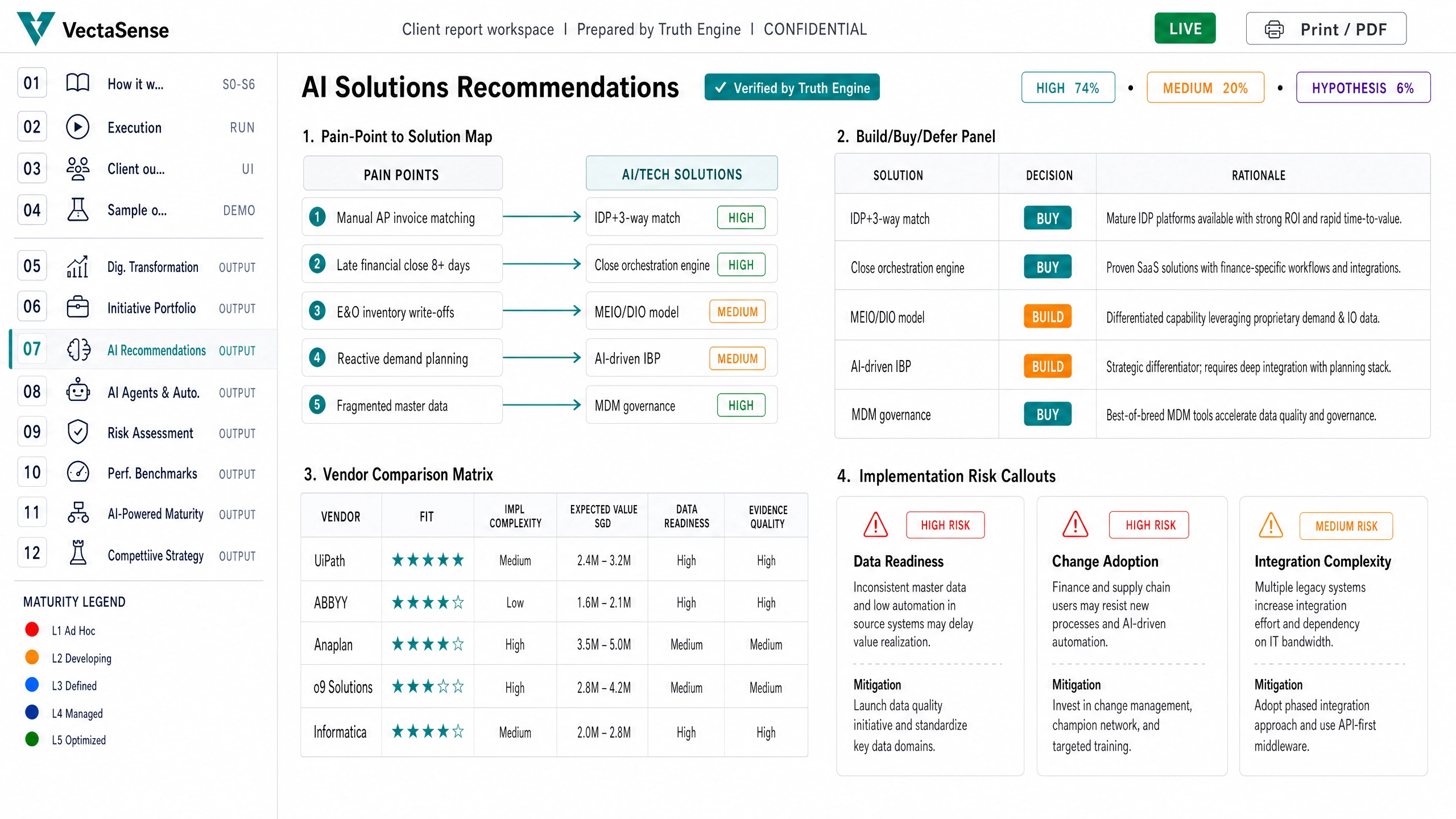
Proof design
Value is made measurable before execution starts.
The expensive mistakes are buying a tool that doesn't touch the priority problem, and underestimating what adoption demands — both come from leading with the technology. Leading with the problem, and labeling thin evidence as Qualified rather than overstating it, avoids both. Related outputs: AI Agents & Automation and AI-Powered Maturity Assessment.
Leadership focus
Core questions and strategic considerations.
- Which AI use cases map to our most material pain points?
- Which tools fit our current stack and data readiness?
- Where should we build, buy, or defer?
- What has to change operationally before an AI solution creates value?
04
Does Vectasense recommend specific vendors?
Vectasense compares solution categories and vendors where evidence supports it. It does not invent partner relationships or endorsements. Any recommendation is tied to fit, implementation evidence, integration constraints, and measurable value.
05
Can this include build-versus-buy analysis?
Yes — especially where the decision depends on data ownership, integration complexity, total cost, speed to value, and whether the capability creates strategic differentiation.
Next step
Scope this solution around the decision you need to make first.
Last updated: June 2026